126080508397
“It’s as if the artist is the animal and the painting is the record
of the artist’s tracks through space and time … I did not want just a
record, but rather the actual movement.”
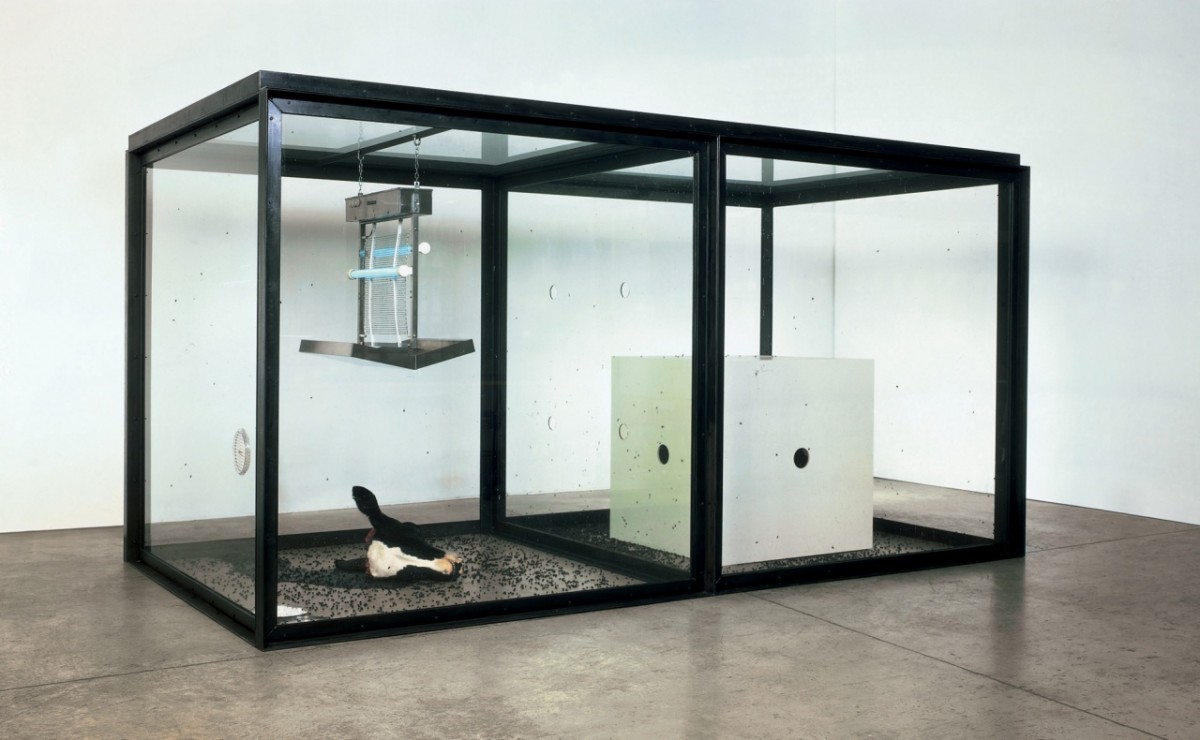
‘A Thousand Years’ and ‘A Hundred Years’ were first exhibited at the warehouse show ‘Gambler’, in 1990. ‘A Thousand Years’ is acknowledged by the artist to be one of the most important of his career.
In both works, the vitrine is split in half by a glass wall: a hole
in this partition allows newly hatched flies from a box reminiscent of a
die in one half, to fly into the other where an Insect-O-Cutor hangs.
The corpses of the flies inside the vitrine accumulate whilst the works
are on exhibition. In ‘A Thousand Years’, a decaying cow’s head is
presented beneath the fly-killer.
Hirst describes how, having come round to the idea of the validity of “new art” and having made the spot paintings and the ‘Medicine Cabinets’,
he felt he had lost something, “in terms of the belief I had in whether
[art] was real or not.” Feeling the need to make “something about something
important”, and having already worked with flies, maggots and
butterflies, whilst at Goldsmiths, he decided to create a “life cycle in
a box.” The structure was partially inspired by American minimalism and the
industrial materials Hirst had seen in the work of Grenville Davey and
Tony Cragg. The shape of the vitrine drew from Francis Bacon’s technique
of framing his figures within box shapes. Of the influence of Bacon’s
frames to his work, Hirst has explained: “it’s a doorway, it’s a window;
it’s two-dimensional, it’s three-dimensional; he’s thinking about the
glass reflecting.”
Having planned the works for almost two years, Hirst had to borrow
money from friends in order to finance their fabrication. Despite this,
he insisted on making two, “like bookends”.
Throughout his career, pairs and duplicates have remained an important
element to Hirst’s work. He states: “It undermines this idea of being
unique. There’s a comfort I get from it that I love. Each part of a pair
has its own life, independent of the other, but they live together.”
‘A Thousand Years’ and ‘A Hundred Years’ synthesize two forces
central to Hirst’s work: the desire to create an aesthetically
successful visual display, and an exploration into the deep profundities
of life and death. Although admitting to having a “Frankenstein moment”
of horror at the death of the flies, the use of living creatures
enabled Hirst to incorporate an element of movement into the
works. After studying Naum Gabo, Hirst found that the flies successfully
satisfied his ambition to “suspend things without strings or wires and have them constantly change pattern in space”.
The artist Lucian Freud stated that, with ‘A Thousand Years’ being
one of his earliest exhibited pieces, Hirst had perhaps “started with
the final act”. Explaining that, “your whole life could be like
points in space, like nearly nothing,” Hirst provokes a reconsideration
of how we respond to death in the works; the fate of the flies at the
hands of a machine that is commonplace even in vegetarian restaurants,
is rendered uncomfortable by the gallery setting. Of the thematic prevalence of death in his work, Hirst explains: “You
can frighten people with death or an idea of their own mortality, or it
can actually give them vigour.”
by Damien Hirst