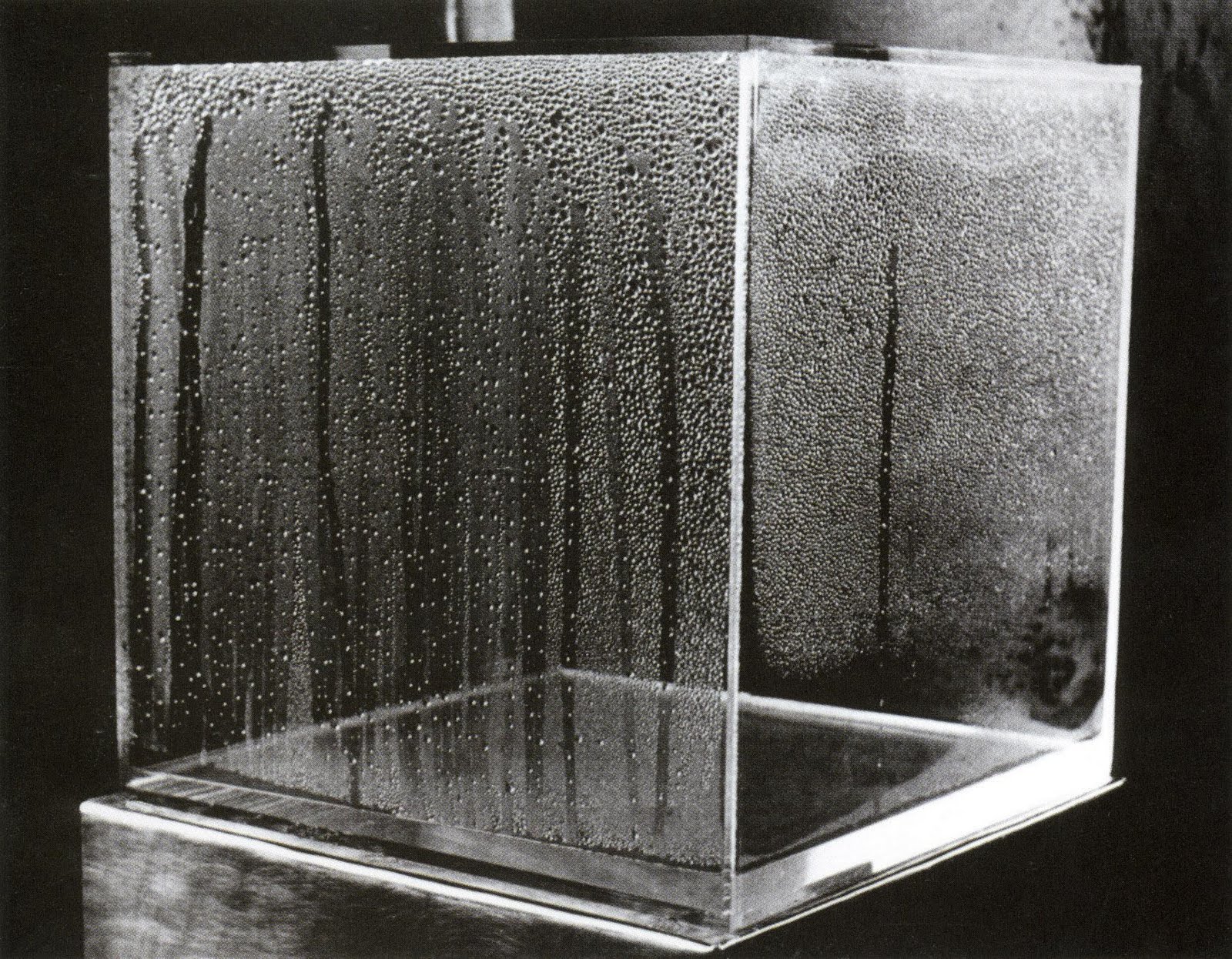
Hans Haacke, Condensation Cube, 1963-65 Installation
“I have partially filled Plexiglas containers of a simple stereometric form with water and have sealed them. The intrusion of light warms the inside of the boxes. Since the inside temperature is always higher that the surrounding temperature, the water enclosed condenses: a delicate veil of drops begins to develop on the inside walls. At first they are so small that one can distinguish single drops from only a very close distance. The drops grow, hour by hour, small ones combine with larger ones. The speed of growth depends on the intensity and the angle of the intruding light. After a day, a dense cover of clearly defined drops has developed and they all reflect light. With continuing condensation, some drops reach such a size that their weight overcomes the forces of adhesion and they run down along the walls, leaving the trace. This trace starts to grow together again. Weeks after, manifold traces, running side by side, have developed. According to their respective age, they have drops of varying sizes. The process of condensation does not end. The box has a constantly but slowly changing appearance that never repeats itself. The conditions are comparable to a living organism that reacts in a flexible manner to its surroundings. The image of condensation cannot be precisely predicted. It is changing freely, bound only by statistical limits. I like this freedom.”
“It’s all about money, not freedom, y’all, okay? Nothing to do with fuckin’ freedom. If you think you’re free, try going somewhere without fucking money, okay?”
“When works of art are presented like rare butterflies on the walls, they’re decontextualized. We admire their beauty, and I have nothing against that, per se. But there is more to art than that.”
“It is impossible for someone to lie unless he thinks he knows the truth. Producing bullshit requires no such conviction. A person who lies is thereby responding to the truth, and he is to that extent respectful of it. When an honest man speaks, he says only what he believes to be true; and for the liar, it is correspondingly indispensable that he considers his statements to be false. For the bullshitter, however, all these bets are off: he is neither on the side of the true nor on the side of the false. His eye is not on the facts at all, as the eyes of the honest man and of the liar are, except insofar as they may pertain to his interest in getting away with what he says. He does not care whether the things he says describe reality correctly. He just picks them out, or makes them up, to suit his purpose.”
“Those who engage in public corrections of this sort often are looking to feel good about themselves, and, according to Benoît Monin, a psychology professor at Stanford University, displays of language all-knowing-ness provide a ready-made, two-pronged opportunity to do so. ‘The way we evaluate our competence is relative to other people,’ he says. ‘If I need to feel good about my language skills, one way that I could do that would be to give myself evidence that my language skills are awesome. Another is to give myself evidence that other people’s language skills suck. So by putting down other people, I can feel better about myself.’”
“The male ego can in some cases be tied to how and where a man sees his place in the world and whether he’s living up to expectations — his and those of society.
Cultural stereotypes for men can be intricately tied to both the inflation and deflation of the male ego. Some men measure themselves by the answers to the following questions:
Am I strong enough? Am I wealthy enough? Do I meet the traditional definition of masculinity? Do I attract women? Do I control things or people? Do people recognize me for these things and am I respected and revered for them?”