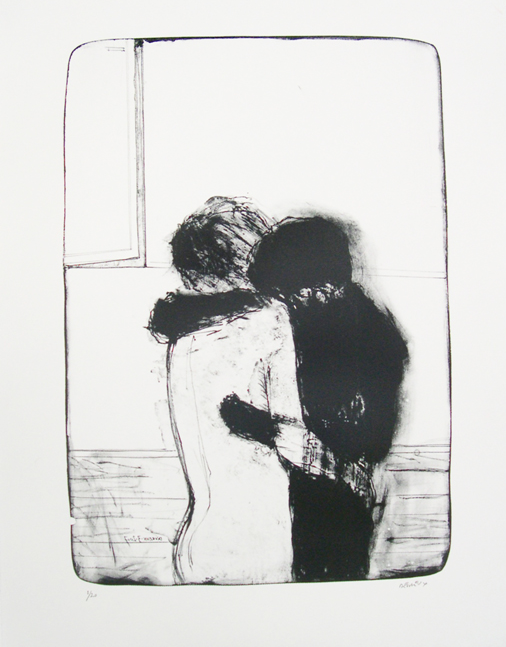
Bischoff, who in 1976 told Paul Karlstrom: “I’m still supporting myself by teaching,” had only two one man shows before his first New York show at Staempfli Gallery in 1960, including a 1955 show at the Paul Kantor Gallery in Los Angeles from which nothing sold. In contrast, leading artists in New York benefitted from a booming art market. For example, Willem de Kooning’s 1959 New York show sold out on the first day, bringing in about $150,000 (about $1.2 million dollars today, when adjusted for inflation).
Of course, de Kooning was a sensation, but many other New York artists sold well while California artists struggled. In this situation, decently paying teaching jobs were a rare and precious commodity. When it was rumored in 1955 that David Park had been offered $10,000 per year to teach at UC Berkeley, artist Nathan Oliveira – who at the time was earning $2.50 per hour teaching art 18 hours per week – thought that Park had been given “the opportunity of a lifetime.” As it turns out, Park’s actual starting annual salary was $5,300.00.
Elmer Bischoff Seated Figure in Garden 1958 Oil on canvas 47 ¾ × 56 3/4in. Whitney Museum of American Art, New York
Object-Oriented Ontology (OOO) isn’t an art movement originally, but a philosophical framework that’s had influence in contemporary art and theory.
Here’s the gist:
What it is: OOO is a branch of speculative realism, developed mainly by Graham Harman, Levi Bryant, and Ian Bogost in the early 2000s.
Core idea: Objects exist independently of human perception. A chair, a rock, a virus, or even a fictional character has its own reality that isn’t reducible to how humans experience or use it.
Why it matters for art: Traditional Western art has long been human-centered — even abstract or minimalist works are often framed around human meaning or perception. OOO pushes back against this “anthropocentrism.”
In art practice: Artists influenced by OOO often explore the agency of objects themselves, how materials interact with each other, or how nonhuman entities (machines, ecosystems, algorithms) shape reality. This can look “anti-human figure” because the focus shifts from people to things.
Examples in art influenced by OOO:
Installations where objects “confront” viewers as independent beings.
Works that emphasize materiality — like how steel, plastic, or digital code behaves on its own.
Ecological and post-humanist art that treats humans as just one actor among many.
So in a sense, OOO isn’t anti-human like Suprematism or Constructivism were, but it de-centers humans — making the human figure no longer the default subject of art.
“I wanted to make something visual, physical, visceral to reflect the butchery they are inflicting on our planet: a visual scream that gives voice to the calamitous cost of the climate crisis, often on the most marginalised communities across the globe. BUTCHERED is also a tribute to the heroic work done in opposition to this destruction, and to the tireless activists who choose to disrupt, disagree and disobey.” — Anish Kapoor