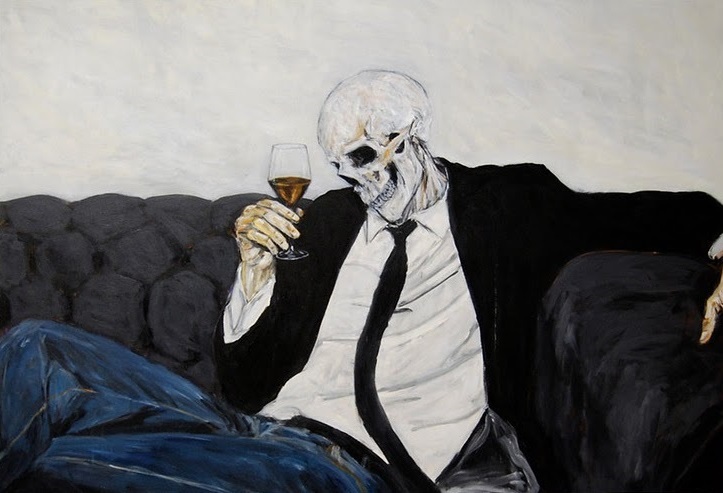
“Those who engage in public corrections of this sort often are looking to feel good about themselves, and, according to Benoît Monin, a psychology professor at Stanford University, displays of language all-knowing-ness provide a ready-made, two-pronged opportunity to do so. ‘The way we evaluate our competence is relative to other people,’ he says. ‘If I need to feel good about my language skills, one way that I could do that would be to give myself evidence that my language skills are awesome. Another is to give myself evidence that other people’s language skills suck. So by putting down other people, I can feel better about myself.’”
“There are different reasons why people bully, including wanting to dominate others and improve their social status, having low self-esteem and wanting to feel better about themselves, and lacking remorse or failing to recognize their behavior as a problem.”
Bischoff, who in 1976 told Paul Karlstrom: “I’m still supporting myself by teaching,” had only two one man shows before his first New York show at Staempfli Gallery in 1960, including a 1955 show at the Paul Kantor Gallery in Los Angeles from which nothing sold. In contrast, leading artists in New York benefitted from a booming art market. For example, Willem de Kooning’s 1959 New York show sold out on the first day, bringing in about $150,000 (about $1.2 million dollars today, when adjusted for inflation).
Of course, de Kooning was a sensation, but many other New York artists sold well while California artists struggled. In this situation, decently paying teaching jobs were a rare and precious commodity. When it was rumored in 1955 that David Park had been offered $10,000 per year to teach at UC Berkeley, artist Nathan Oliveira – who at the time was earning $2.50 per hour teaching art 18 hours per week – thought that Park had been given “the opportunity of a lifetime.” As it turns out, Park’s actual starting annual salary was $5,300.00.
Elmer Bischoff Seated Figure in Garden 1958 Oil on canvas 47 ¾ × 56 3/4in. Whitney Museum of American Art, New York
“Children in Shizuoka need more models. I thought I was making things, but I wasn’t. I want them to develop the habit of making things with their own hands.” — RIP Shunsaku Tamiya
“So bullshitting isn’t just nonsense. It’s constructed in order to appear meaningful, though on closer examination, it isn’t. And bullshit isn’t the same as lying. A liar knows the truth but makes statements deliberately intended to sell people on falsehoods. bullshitters, in contrast, aren’t concerned about what’s true or not, so much as they’re trying to appear as if they know what they’re talking about. In that sense, bullshitting can be thought of as a verbal demonstration of the Dunning-Kruger effect—when people speak from a position of disproportionate confidence about their knowledge relative to what little they actually know, bullshit is often the result.”
By being treated in these damaging ways, the child learns that being yourself is dangerous, that in order to survive and be at least marginally accepted by your caregivers, you have to hide who you really are: your thoughts, observations, feelings, and preferences.
Other times the child decides to lie to get their needs met, needs that otherwise would be completely ignored. For example, if the caregivers are emotionally distant, the child might lie or pretend that somethings going on just to receive some attention.
And, of course, if the child is routinely attacked or rejected for being authentic, they learn to hide and pretend. In many cases, to the degree where they gradually lose connection to their authentic self and have no idea anymore who they really are.
This is tragic. However, its important to realize that, as adults, we don’t have to be afraid of abandonment anymore. We don’t need our caregivers to survive. We can endure and deal with all these feelings of betrayal, hurt, distrust, shame, loneliness, anger, and many others.
As adults we can slowly untangle all of these problems and slowly rediscover who we really are. We also can start working on trusting others who actually are trustworthy. We can become authentic again.