book
155238451267
The teaching which you have heard, however, is not my opinion, and
its goal is not to explain the world to those who are thirsty for
knowledge. Its goal is quite different; its goal is salvation from
suffering. That is what Gotama teaches, nothing else.
I have never seen a man look and smile, sit and walk like that, he
thought. I, also, would like to look and smile, sit and walk like that,
so free, so worthy, so restrained, so candid, so childlike and
mysterious. A man only looks and walks like that when he has conquered
his self. I also will conquer my self.
—Siddhartha (novel) p. 35 by Hermann Hesse
154605523027
What could I say to you that would be of value, except that perhaps you seek too much, that as a result of your seeking you cannot find. … When someone is seeking, it happens quite easily that he only sees the thing that he is seeking; that he is unable to find anything, unable to absorb anything, because he is only thinking of the thing he is seeking, because he has a goal, because he is obsessed with his goal. Seeking means: to have a goal; but finding means: to be free, to be receptive, to have no goal. You, O worthy one, are perhaps indeed a seeker, for in striving towards your goal, you do not see many things that are under your nose.
154454278462
How strange it is! Now, when I am no longer young, when my hair is fast growing gray, when strength begins to diminish, now I am beginning again like a child.
153429115412
152154493697
If people bring so much courage to this world the world has to kill them to break them, so of course it kills them. The world breaks every one and afterward many are strong at the broken places. But those that will not break it kills. It kills the very good and the very gentle and the very brave impartially. If you are none of these you can be sure it will kill you too but there will be no special hurry.
151423621262
Texts and Pretexts (1932), p. 270.
“It is man’s intelligence that makes him so often behave more stupidly
than the beasts. … Man is impelled to invent theories to account for
what happens in the world. Unfortunately, he is not quite intelligent
enough, in most cases, to find correct explanations. So that when he
acts on his theories, he behaves very often like a lunatic. Thus, no
animal is clever enough, when there is a drought, to imagine that the
rain is being withheld by evil spirits, or as punishment for its
transgressions. Therefore you never see animals going through the absurd
and often horrible fooleries of magic and religion. No horse, for
example would kill one of its foals to make the wind change direction.
Dogs do not ritually urinate in the hope of persuading heaven to do the
same and send down rain. Asses do not bray a liturgy to cloudless skies.
Nor do cats attempt, by abstinence from cat’s meat, to wheedle the
feline spirits into benevolence. Only man behaves with such gratuitous
folly. It is the price he has to pay for being intelligent but not, as
yet, intelligent enough.”—Aldous Huxley
151389931112








151014867082
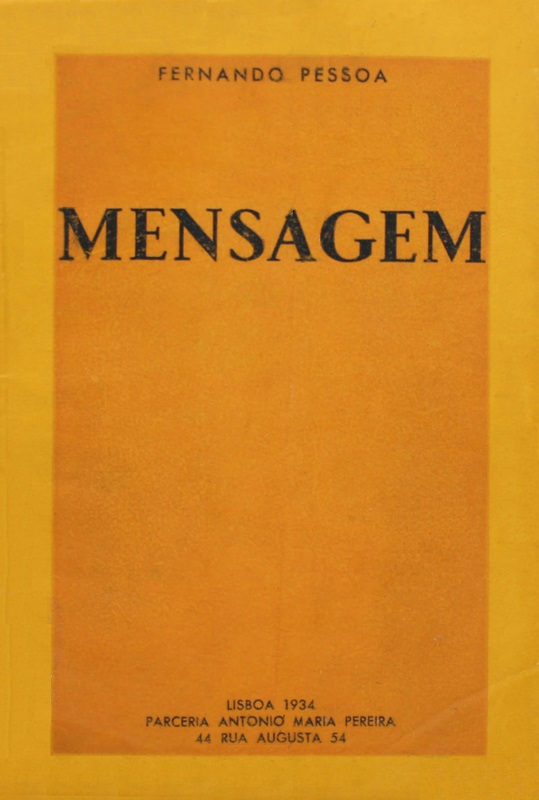
Mensagem, first edition, 1934 by Fernando Pessoa
150719798687
Promise me you’ll always remember: You’re braver than you believe, and stronger than you seem, and smarter than you think.
150306652932

148968402332
Inside the Godfather
By Daryl Brown, Michael P. Chabries
I Feel Good
I have taken you Inside the Godfather in a way that few, if any, have been able. I am grateful for those who have shared their stories. Thank you.
This final chapter includes some of my fondest memories of James Brown. They are not in any particular order. These are reflections of people, places, and events that would have him say, “Wo! I feel good.”
The most important idea I want you to understand about my father was something he often said: “When God resurrects you you got to resurrect others.”
In 1987, my father announced his intention to give the children of Georgia and South Carolina most of his wealth. He established a trust fund for the poor and needy children to receive funds for their education. It was estimated the trust fund would have been worth $100,000,000. If you knew my father at all, he never wanted any child
to suffer as he did. Smiles he witnessed on their faces brought a sense of pride that was only equaled by the joy he felt performing.
Similarly, the practice of giving away as many as a thousand turkeys at Thanksgiving was one of the highlights of his year. He began the day with a public prayer, sang with a gospel choir, and shook the hands of the crowd that lined up for blocks to see
the Godfather.
He was never able to leave the scars from his childhood behind. Memories of hunger pangs in Barnwell and Augusta motivated him to provide an annual feast for those who were equally hungry. These were his people. He loved them. Writing that check was easy.
Some families made it through the line twice. It was easy to spot them and some people encouraged my father to withhold his generosity. The thought never crossed his mind. He believed if they needed a second turkey – this was a way for God to provide.
My father loved Christmas. He loved to sing at Christmas and provide hundreds of thousands of dollars in toys for children. He gave back to his community much more than the annual toy giveaway in Augusta. His generosity started back in the 1960s, and never stopped until he died on Christmas day. In particular, he loved to give bicycles to boys and dolls to girls. More importantly, he wanted each child to pick something out that would make them happy. He didn’t want their parents or his staff to pick out a toy for them; that was the privilege of the child.
If he ran low on toys or turkeys, he simply turned to his staff and said, “Go buy more, people are still waiting in line.” He may have single-handedly saved the toy stores in Augusta.
Danny Ray, his Cape Man said: “Mr. Brown used to give away a lot of things. He would give away toys to kids. He used to tell me, ‘These are things I never had. I never had anything like this. I had to pick cotton in Carolina.’ Around Christmas time he would take
care of the kids. He knew the kids didn’t have a lot of things. If he saw a kid, he would give them whatever he could. He would also try to help the moms. Shoot yeah. He started the Christmas thing because of his memory of being a kid.
It was tough with his daddy thing. He would walk from Barnwell, South Carolina all the way over to Augusta, Georgia.
‘More than 50 miles,’ he said. ‘The first bicycle I got, Glen gave it to me. I rode that bike everywhere.’ That is why he gave so many kids bikes. It was better than walking. He also started the toy giveaway. He didn’t like to see kids with sad faces. I think he enjoyed watching the kids smile more than even the kid did
getting a present.
His Christmas decorations were legendary in Augusta. Thousands of eager spectators drove to see the famous black Santa when he lived up on the hill. What most people don’t know – he was Black Santa. He loved to give all year long. He didn’t really care if you were naughty or nice; James Brown did not want to see you suffer. He would gladly endure pain for you if he could benefit your life. He never saw color, he only saw need.
It is no coincidence that he died just after the toy giveaway. The thought of this day brought life to a dead man. His life was essentially over as soon as the toy giveaway ended in 2006.
He gave away millions of dollars to the needy during his lifetime. He paid medical bills, rebuilt houses, paid utility bills, and provided hundreds of thousands of dollars in groceries to the needy. He loved to buy school supplies for children. It was his way of telling them to “stay in school.”
My father loved to tip big for those who really took care of him. I know he tipped many people ten thousand dollars for their simple service. He loved to take care of single mothers who were waiting tables in restaurants. The money he had was not his. He
never hesitated to give back. When he didn’t have money, it
saddened him.
Not because he would go without, but because he
could not help others in need. That was the role of the Godfather.
Sadly, Christmas was a time of loneliness and despair for my father. He missed Alphie (heaven only knows why) and he missed the hand, his staff, and his friends that were occupied with their families. He was so hard on the band but in an odd way they were his dysfunctional family – the only family he really ever had.
James Brown loved to give his employees a healthy Christmas bonus. Certain years he was not able to provide a bonus – he barely made payroll. This brought about a sense of despair for Mr. “I feel good.”
He wanted people to believe in themselves. When he wrote, “Say it loud, I’m black and I’m proud” he was really trying to get his people to “get up on the good foot.”
When he saw homeless and unemployed people he became frustrated. It was one thing to be working and poor. It was quite another to simply waste your life away. He said, “Don’t give me a handout; give me a way out.” He would talk to homeless people in shelters and do what he could to simply get them to move. That was the very essence of his music; it moved body and soul. “Wear your hat in the direction you want your life to go.” Move forward not backward…
148689493402

147108438283

147055756212

New alphabet, 1967 by Wim Crouwel