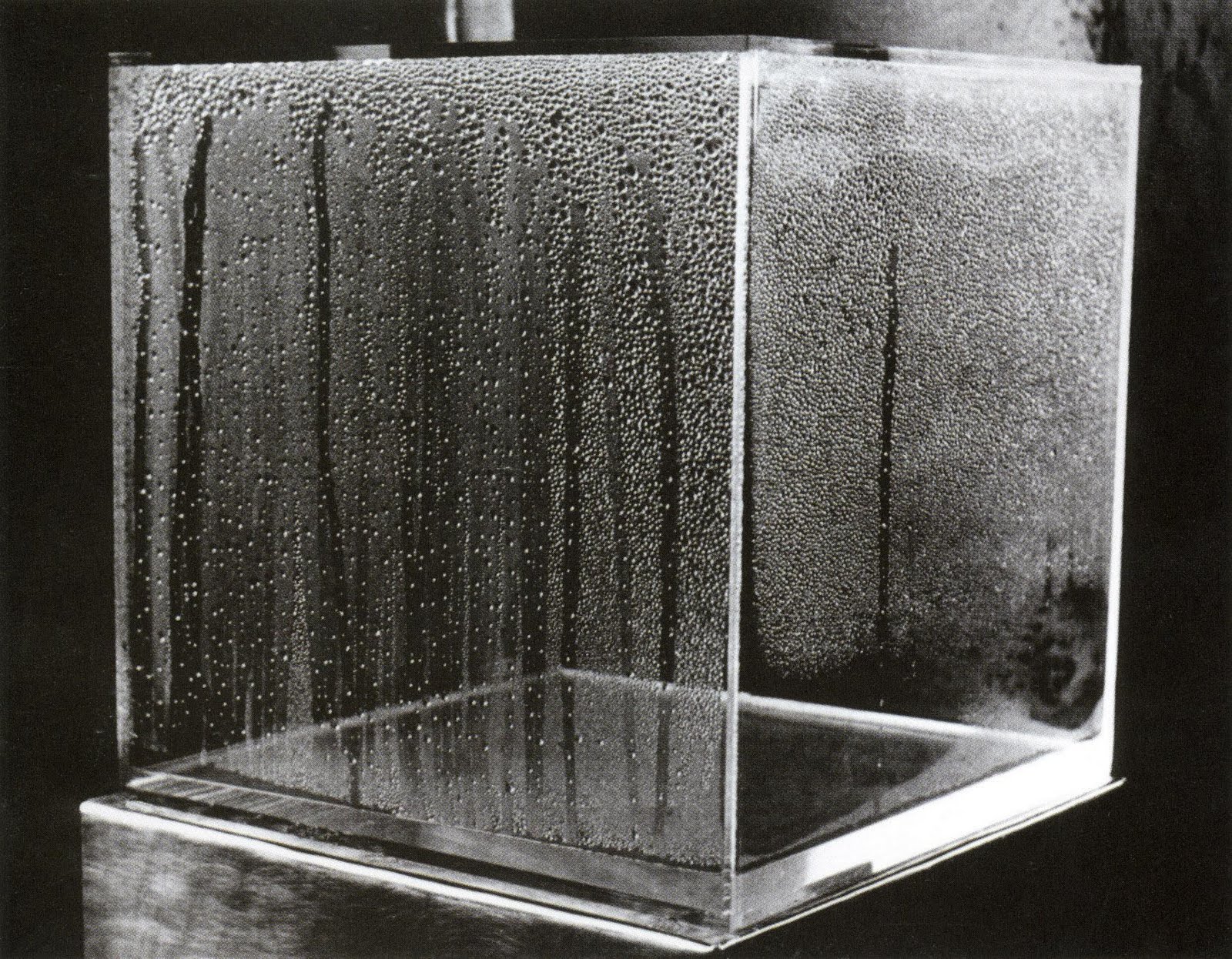
Hans Haacke, Condensation Cube, 1963-65 Installation
“I have partially filled Plexiglas containers of a simple stereometric form with water and have sealed them. The intrusion of light warms the inside of the boxes. Since the inside temperature is always higher that the surrounding temperature, the water enclosed condenses: a delicate veil of drops begins to develop on the inside walls. At first they are so small that one can distinguish single drops from only a very close distance. The drops grow, hour by hour, small ones combine with larger ones. The speed of growth depends on the intensity and the angle of the intruding light. After a day, a dense cover of clearly defined drops has developed and they all reflect light. With continuing condensation, some drops reach such a size that their weight overcomes the forces of adhesion and they run down along the walls, leaving the trace. This trace starts to grow together again. Weeks after, manifold traces, running side by side, have developed. According to their respective age, they have drops of varying sizes. The process of condensation does not end. The box has a constantly but slowly changing appearance that never repeats itself. The conditions are comparable to a living organism that reacts in a flexible manner to its surroundings. The image of condensation cannot be precisely predicted. It is changing freely, bound only by statistical limits. I like this freedom.”
“Art has been valued and given importance through the artist, regarded as the one who creates something wondrous and beautiful. At a certain point, artists within that way of thinking often distance themselves more and more from the community and society. In Thai education, this system of teaching and learning art is still being used.”
“When art is no longer the center of the universe, then artists are not either. This has been a question asked of artists since the time of Walter Benjamin. He spoke about this long ago, and it has been written about for a long time.
“In the modernist view, the artist was seen as something close to a superhuman — exalted as someone with supreme specialness, with an intuition that could not be explained. When the artist was elevated above us, above the university guard or the noodle vendor next door, the artist became like a kind of demi-god, regarded as more special than anyone else.
“In fact, in contemporary thought, the artist is like a motorcycle taxi driver — it’s just another profession. We work within a framework of knowledge that is not some kind of miracle. And art itself depends on other bodies of knowledge.”
Jiradej Meemalai Co-founder of ‘Baan Noorg Collaborative Arts & Culture’
“เมื่อศิลปะไม่เป็นศูนย์กลางจักรวาล ศิลปินก็จะไม่เป็นด้วย ซึ่งศิลปินเคยถูกตั้งคำถามนี้มาตั้งแต่สมัย Benjamin Walter เขาพูดเรื่องนี้มานานแล้ว หนังสือก็เขียนมานานแล้ว
“Christie’s is closing its digital art department and has parted ways with Nicole Sales Giles, the auction house’s vice president of digital, Now Media reported Monday.”
“I still think science is looking for answers and art is looking for questions.” ⠀ Quinn sees the skeleton as representative of an everyman, an abstraction of a person since it is the part of the body which transcends death. The sculptures Angel and Waiting for Godot take the form of a praying skeleton and are an ironic reference to the idea of waiting for answers – or for some kind of external power to guide our life. ⠀ Marc Quinn Waiting for Godot 2006 Patinated bronze 77h x 37w x 76.5d cm
“Real art doesn’t have a message, doesn’t necessarily say anything. It is an arrangement of shapes, a pattern of words. If you want an antidote to this idea of art, watch Bob Dylan manically arranging and rearranging words on a shop sign he and the band spotted one day. That is art.”
Ideas have fathers One of the many destructive assumptions nowadays is that ideas have no fathers. But ideas are thought up by someone. For example, the concept of placing a sculpture on the ground without a plinth was one of Judd’s ideas; it is now very common and no one is aware of this. Another one of his ideas was the concept of the installation, the use of the whole space. Many artists devalue this idea. Once again there is no discussion at all and mediocre works are created. Art historians who are concerned with the past are at least still interested in chronology, those who work with contemporary art are not, and they see art as the subject for their own speculations.
Artist Donald Judd (1928 – 1994) held the 1993 Mondrian Lecture called ‘Some aspects of colour in general and red and black in particular’.