Buddha
665343545972031488
Buddhist Explanation of Karma
665063765135540224
The steps of the Noble Eightfold Path are Right Understanding, Right Thought, Right Speech, Right Action, Right Livelihood, Right Effort, Right Mindfulness, and Right Concentration.
641852101374476288
190754465522
กำเนิดวัฏสงสาร เราเกิดมาได้ยังไง? โดย พระมหาวรพรต กิตติวโร
188173374427
The Rules for being Human
01. You will receive a body. You may like it or hate it, but it’s the only thing you are sure to keep for the rest of this life.
02. You will learn lessons. You are enrolled in a full-time informal school called “Life On Planet Earth”. Every person or incident is the Universal Teacher.
03. There are no mistakes, only lessons. Growth is a process of experimentation. “Failures” are as much a part of the process as “successes”.
04. A lesson is repeated until learned. It is presented to you in various forms until you learn then you can go on to the next lesson.
05. If you don’t learn easy lessons, they get harder. External problems are a precise reflection of your internal state. When you learn inner obstructions, your outside world changes. Pain is how the universe gets your attention.
06. You will know you’ve learned a lesson when your actions change. Wisdom is practice. A little of something is better
than a lot of nothing.
07. “There” is no better than “here.” When your “there” becomes a “here” you will simply obtain another “there” that again looks better than “here.”
08. Others are only a mirror of you. You cannot love or hate something about another unless it reflects something you love or hate
about yourself.
09. Your life is up to you. Life provides the canvas; you do the painting. Take charge of your life-or someone else will.
010. You always get what you want. Your subconscious rightfully determines what energies, experiences and people you attract therefore, the only foolproof way to know what you want, is to see what you have. There are no victims, only students.
011. There is no right or wrong, but there are consequences. Moralizing doesn’t help. Judgments only hold the patterns in place. Just do your best.
012. Your answers lie inside you. Children need guidance from others; as we mature; we trust our hearts, where the Laws of Spirit are written. You know more than you have heard read or been told. All you need to do is to look, listen and trust.
013. You will forget all this.
014. You can remember any time you wish.
From the Los Angeles Resources Newspaper, March 1994
188167429517
The Gates of Paradise
A soldier named Nobushige came to Hakuin, and asked: “Is there really a paradise and a hell?”
“Who are you?” inquired Hakuin.
“I am a samurai,” the warrior replied.
“You, a soldier!” exclaimed Hakuin. “What kind of ruler would have you as his guard? Your face looks like that of a beggar.”
Nobushige became so angry that he began to draw his sword, but Hakuin continued: “So you have a sword! Your weapon is probably much too dull to cut off my head.”
As Nobushige drew his sword Hakuin remarked: “Here open the gates of hell!”
At these words the samurai, perceiving the master’s discipline, sheathed his sword and bowed.
“Here open the gates of paradise,” said Hakuin.
188045649942
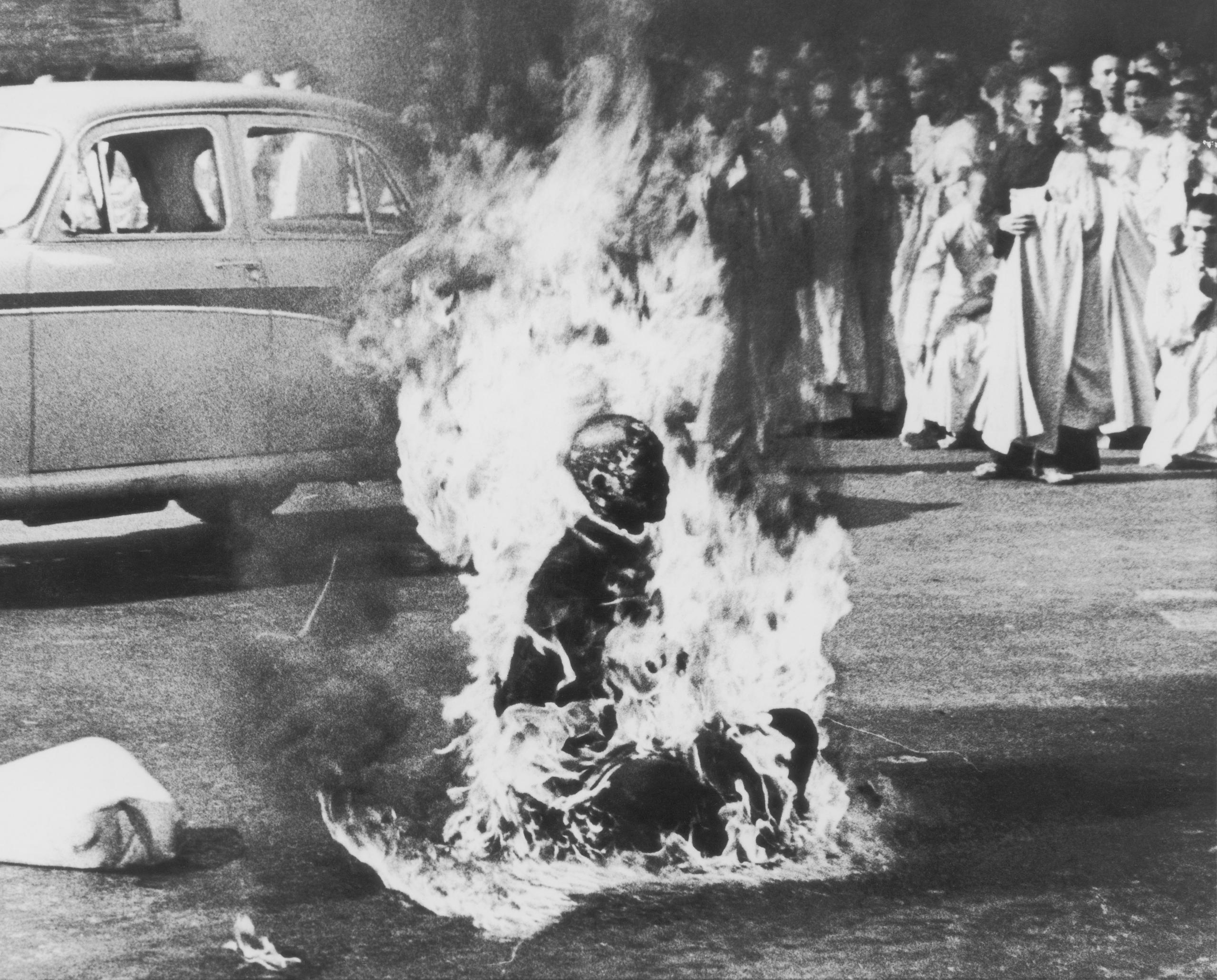
Thich
Quang Duc had prepared himself for his self-immolation through several
weeks of meditation and had explained his motivation in letters to
members of his Buddhist community as well as to the government of South
Vietnam in the weeks prior to his self-immolation. In these letters he
described his desire to bring attention to the repressive policies of
the Catholic Diem regime that controlled the South Vietnamese government
at the time. Prior to the self-immolation, the South Vietnamese
Buddhists had made the following requests to the Diem regime, asking it
to:
1. Lift its ban on flying the traditional Buddhist flag;
2. Grant Buddhism the same rights as Catholicism;
3. Stop detaining Buddhists;
4. Give Buddhist monks and nuns the right to practice and spread their religion; and
5. Pay fair compensations to the victim’s families and punish those responsible for their deaths.
163205933982
Alan Watts Death (1959) [full length]
155239324342
The sun and moon had always shone; the rivers had always flowed and
the bees had hummed, but in previous times all this had been nothing to
Siddhartha but a fleeting and illusive veil before his eyes, regarded
with distrust, condemned to be disregarded and ostracized from the
thoughts, because it was not reality, because reality lay on the other
side of the visible. But now his thoughts lingered on this side; he saw
and recognized the visible and he sought his place in this world. He did
not seek reality; his goal was not on any other side. The world was
beautiful when looked at in this way—without any seeking, so simple, so
childlike. The moon and the stars were beautiful, the brook, the shore,
the forest and the rock, the goat and the golden beetle, the flower and
the butterfly were beautiful. It was beautiful and pleasant to go
through the world like that, so childlike, so awakened, so concerned
with the immediate, without any distrust. …
All this had always been and he had never seen it; he was never
present. Now he was present and belonged to it. Through his eyes he saw
light and shadows; through his mind he was aware of moon and stars.
—Siddhartha (novel) pp. 45-46 by Hermann Hesse
155238451267
The teaching which you have heard, however, is not my opinion, and
its goal is not to explain the world to those who are thirsty for
knowledge. Its goal is quite different; its goal is salvation from
suffering. That is what Gotama teaches, nothing else.
I have never seen a man look and smile, sit and walk like that, he
thought. I, also, would like to look and smile, sit and walk like that,
so free, so worthy, so restrained, so candid, so childlike and
mysterious. A man only looks and walks like that when he has conquered
his self. I also will conquer my self.
—Siddhartha (novel) p. 35 by Hermann Hesse
154605523027
What could I say to you that would be of value, except that perhaps you seek too much, that as a result of your seeking you cannot find. … When someone is seeking, it happens quite easily that he only sees the thing that he is seeking; that he is unable to find anything, unable to absorb anything, because he is only thinking of the thing he is seeking, because he has a goal, because he is obsessed with his goal. Seeking means: to have a goal; but finding means: to be free, to be receptive, to have no goal. You, O worthy one, are perhaps indeed a seeker, for in striving towards your goal, you do not see many things that are under your nose.
154454278462
How strange it is! Now, when I am no longer young, when my hair is fast growing gray, when strength begins to diminish, now I am beginning again like a child.
154454224492
Develop Your Heart | Ajahn Brahm | 2 Dec 2016