Buddhism
788164340550369280
Why Zen practice doesn’t focus on death
In Zen practice, death is not considered important in the conventional sense because Zen emphasizes direct experience of reality beyond concepts, including life and death. Zen points to the present moment as the only true reality, rather than being attached to the past or future, including concerns about death.
Here are a few key reasons why death is not a central concern in Zen:
- No Fixed Self – Zen teaches that the self is not a fixed, separate entity but a fluid, interconnected part of existence. If there is no solid “self,” then who is there to die?
- Life and Death Are One – Rather than seeing life and death as opposing forces, Zen regards them as two aspects of the same reality. Dogen Zenji, the founder of Soto Zen, wrote about shoji (life-death) as a seamless flow rather than two separate states.
- Impermanence Is Fundamental – Everything is constantly changing, and clinging to permanence creates suffering. By fully accepting impermanence, fear of death loses its grip.
- Living Fully in the Present – Zen emphasizes complete presence in each moment. Since death is not happening now, focusing on it distracts from experiencing life completely.
- Direct Experience Over Concepts – Zen discourages excessive thinking about abstract concepts like death and instead encourages direct experience of reality as it is.
This doesn’t mean Zen ignores death—it acknowledges it as a natural part of existence. However, instead of fixating on it, Zen practice encourages embracing life fully, letting go of fear, and experiencing each moment completely.
By ChatGPT
785023492197335040
“Health is the greatest gift, contentment the greatest wealth, faithfulness the best relationship.”
784230106108477440
Indeed, religion allows people to imagine that their concerns are moral when they are highly immoral – that is, when pressing these concerns inflicts unnecessary and appalling suffering on innocent human beings. This explains why Christians like yourself expend more “moral” energy opposing abortion than fighting genocide. It explains why you are more concerned about human embryos than about the lifesaving promise of stem-cell research. And it explains why you can preach against condom use in sub-Saharan Africa while millions die from AIDS there each year.
— Sam Harris
782567005300637696
Learning to Be Silent
The pupils of the Tendai school used to study meditation before Zen entered Japan. Four of them who were intimate friends promised one another to observe seven days of silence.
On the first day all were silent. Their meditation had begun auspiciously, but when night came and the oil lamps were growing dim one of the pupils could not help exclaiming to a servant: “Fix those lamps.”
The second pupils was surprised to hear the first one talk. “We are not supposed to say a word,” he remarked.
“You two are stupid. Why did you talk?” asked the third.
“I am the only one who has not talked,” concluded the fourth pupil.
781445134818623488
Indeed, religion allows people to imagine that their concerns are moral when they are highly immoral – that is, when pressing these concerns inflicts unnecessary and appalling suffering on innocent human beings. This explains why Christians like yourself expend more “moral” energy opposing abortion than fighting genocide. It explains why you are more concerned about human embryos than about the lifesaving promise of stem-cell research. And it explains why you can preach against condom use in sub-Saharan Africa while millions die from AIDS there each year.
— Sam Harris
778725761581465600
David Lynch: Consciousness, Creativity and the Brain
778563615357812736
“For me, transcending is like a jolt of bliss. You’re in one place, and then you dip into the transcendent, the field of pure consciousness. It’s like being plugged into an electric circuit; you get a jolt of happiness. It’s very beautiful. And the more you practice this technique, the longer you stay in the transcendent. Short beautiful rides lead to longer beautiful rides. I always say it’s like gold coming in and garbage going out. When you transcend and you’ve experienced this happiness, you have less stress, less depression, less sadness, less fear, less hate, less bitter anger—all negativity starts to dissipate the more you transcend. You start feeling better. You start acting better. You start enjoying more.” — David Lynch
778345188198400000
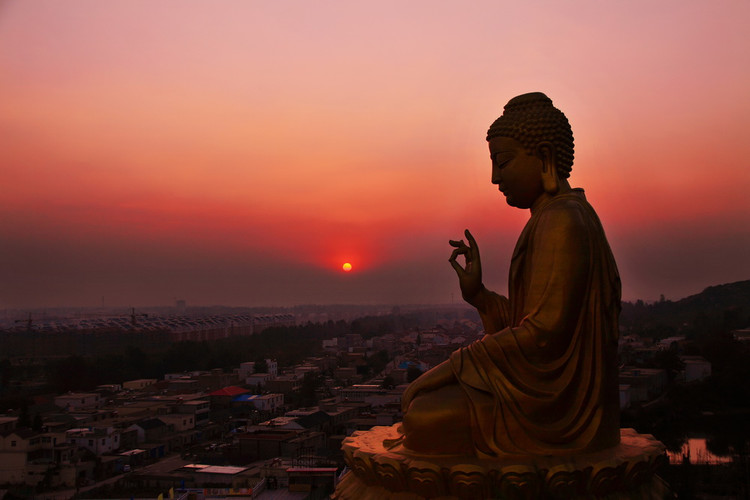
Buddha
Lingshan (Ling Mountain), Jiangsu Province, China
江苏灵山大佛
777041089010008064

776848471423696896
The True Path
Just before Ninakawa passed away the Zen master Ikkyu visited him. “Shall I lead you on?” Ikkyu asked.
Ninakawa replied: “I came here alone and I go alone. What help could you be to me?”
Ikkyu answered: “If you think you really come and go, that is your delusion. Let me show you the path on which there is no coming and going.”
With his words, Ikkyu had revealed the path so clearly that Ninakawa smiled and passed away.
776221733650939904
A Cup of Tea
Nan-in, a Japanese master during the Meiji era (1868-1912), received a university professor who came to inquire about Zen.
Nan-in served tea. He poured his visitor’s cup full, and then kept on pouring.
The professor watched the overflow until he no longer could restrain himself. “It is overfull. No more will go in!”
“Like this cup,” Nan-in said, “you are full of your own opinions and speculations. How can I show you Zen unless you first empty your cup?”
776221389868924928
The Moon Cannot Be Stolen
Ryokan, a Zen master, lived the simplest kind of life in a little hut at the foot of a mountain. One evening a thief visited the hut only to discover there was nothing in it to steal.
Ryokan returned and caught him. “You may have come a long way to visit me,” he told the prowler, “and you shoud not return emptyhanded. Please take my clothes as a gift.”
The thief was bewildered. He took the clothes and slunk away.
Ryokan sat naked, watching the moon. “Poor fellow, ” he mused, “I wish I could give him this beautiful moon.”