Buddhist

81 items found

804801182842454016

donotdestroy:

The Stone Mind

Hogen, a Chinese Zen teacher, lived alone in a small temple in the country. One day four traveling monks appeared and asked if they might make a fire in his yard to warm themselves.

While they were building the fire, Hogen heard them arguing about subjectivity and objectivity. He joined them and said: There is a big stone. Do you consider it to be inside or outside your mind?’

One of the monks replied: ‘From the Buddhist viewpoint everything is an objectification of mind, so I would say that the stone is inside my mind.’

‘Your head must feel very heavy’, observed Hogen. ‘if you are carrying around a stone like that in your mind.’ 

801671998970413056

donotdestroy:

The Stone Mind

Hogen, a Chinese Zen teacher, lived alone in a small temple in the country. One day four traveling monks appeared and asked if they might make a fire in his yard to warm themselves.

While they were building the fire, Hogen heard them arguing about subjectivity and objectivity. He joined them and said: There is a big stone. Do you consider it to be inside or outside your mind?’

One of the monks replied: ‘From the Buddhist viewpoint everything is an objectification of mind, so I would say that the stone is inside my mind.’

‘Your head must feel very heavy’, observed Hogen. ‘if you are carrying around a stone like that in your mind.’ 

799070882538635264

donotdestroy:

The Stone Mind

Hogen, a Chinese Zen teacher, lived alone in a small temple in the country. One day four traveling monks appeared and asked if they might make a fire in his yard to warm themselves.

While they were building the fire, Hogen heard them arguing about subjectivity and objectivity. He joined them and said: There is a big stone. Do you consider it to be inside or outside your mind?’

One of the monks replied: ‘From the Buddhist viewpoint everything is an objectification of mind, so I would say that the stone is inside my mind.’

‘Your head must feel very heavy’, observed Hogen. ‘if you are carrying around a stone like that in your mind.’ 

798422322021269504

donotdestroy:

The sun and moon had always shone; the rivers had always flowed and
the bees had hummed, but in previous times all this had been nothing to
Siddhartha but a fleeting and illusive veil before his eyes, regarded
with distrust, condemned to be disregarded and ostracized from the
thoughts, because it was not reality, because reality lay on the other
side of the visible. But now his thoughts lingered on this side; he saw
and recognized the visible and he sought his place in this world. He did
not seek reality; his goal was not on any other side. The world was
beautiful when looked at in this way—without any seeking, so simple, so
childlike. The moon and the stars were beautiful, the brook, the shore,
the forest and the rock, the goat and the golden beetle, the flower and
the butterfly were beautiful. It was beautiful and pleasant to go
through the world like that, so childlike, so awakened, so concerned
with the immediate, without any distrust. …

All this had always been and he had never seen it; he was never
present. Now he was present and belonged to it. Through his eyes he saw
light and shadows; through his mind he was aware of moon and stars.

—Siddhartha (novel) pp. 45-46 by Hermann Hesse

796682205731700736

donotdestroy:

“Form is emptiness, emptiness is form” states the Heart Sutra, one of the best known ancient Buddhist texts. The essence of all things is emptiness.”

— Eckhart Tolle

795244818712428544

donotdestroy:

The Stone Mind

Hogen, a Chinese Zen teacher, lived alone in a small temple in the country. One day four traveling monks appeared and asked if they might make a fire in his yard to warm themselves.

While they were building the fire, Hogen heard them arguing about subjectivity and objectivity. He joined them and said: There is a big stone. Do you consider it to be inside or outside your mind?’

One of the monks replied: ‘From the Buddhist viewpoint everything is an objectification of mind, so I would say that the stone is inside my mind.’

‘Your head must feel very heavy’, observed Hogen. ‘if you are carrying around a stone like that in your mind.’ 

790845080314478592

donotdestroy:

The Stone Mind

Hogen, a Chinese Zen teacher, lived alone in a small temple in the country. One day four traveling monks appeared and asked if they might make a fire in his yard to warm themselves.

While they were building the fire, Hogen heard them arguing about subjectivity and objectivity. He joined them and said: There is a big stone. Do you consider it to be inside or outside your mind?’

One of the monks replied: ‘From the Buddhist viewpoint everything is an objectification of mind, so I would say that the stone is inside my mind.’

‘Your head must feel very heavy’, observed Hogen. ‘if you are carrying around a stone like that in your mind.’ 

784631312575299584

donotdestroy:

Real Prosperity

A rich man asked Sengai to write something for the continued prosperity of his family so that it might be treasured from generation to generation.

Sengai obtained a large sheet of paper and wrote: “Father dies, son dies, grandson dies.”

The rich man became angry. “I asked you to write something for the happiness of my family! Why do you make such a joke of this?”

“No joke is intended,” explained Sengai. “If before you yourself die your son should die, this would grieve you greatly. If your grandson should pass away before your son, both of you would be broken-hearted. If your family, generation after generation, passes away in the order I have named, it will be the natural course of life. I call this real prosperity.” 

778725761581465600

donotdestroy:

David Lynch: Consciousness, Creativity and the Brain


778563615357812736

“For me, transcending is like a jolt of bliss. You’re in one place, and then you dip into the transcendent, the field of pure consciousness. It’s like being plugged into an electric circuit; you get a jolt of happiness. It’s very beautiful. And the more you practice this technique, the longer you stay in the transcendent. Short beautiful rides lead to longer beautiful rides. I always say it’s like gold coming in and garbage going out. When you transcend and you’ve experienced this happiness, you have less stress, less depression, less sadness, less fear, less hate, less bitter anger—all negativity starts to dissipate the more you transcend. You start feeling better. You start acting better. You start enjoying more.” — David Lynch

778345188198400000
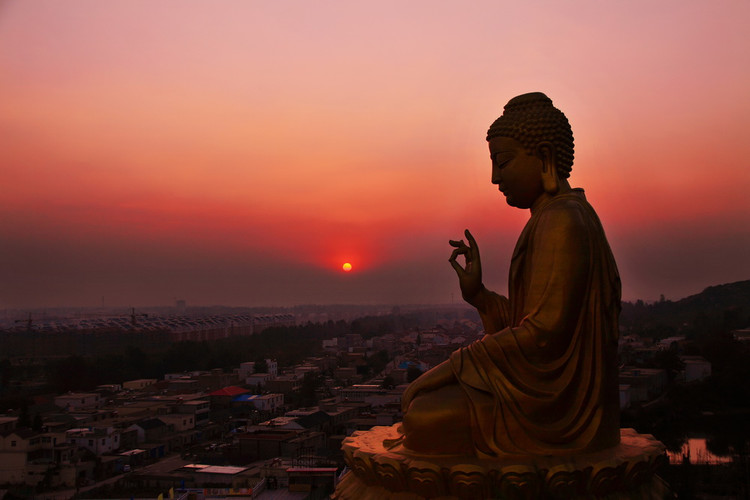
omsutrabuddha:

Buddha

Lingshan (Ling Mountain), Jiangsu Province, China

江苏灵山大佛

772884339979681792

donotdestroy:

David Lynch: Consciousness, Creativity and the Brain


742645394829377536

“Form is emptiness, emptiness is form” states the Heart Sutra, one of the best known ancient Buddhist texts. The essence of all things is emptiness.”

— Eckhart Tolle

732779143622754304

The Buddhist concept of reincarnation differs from others in that there is no eternal “soul,” “spirit” or “self” but only a “stream of consciousness” that links life with life. The actual process of change from one life to the next is called punarbhava (Sanskrit) or punabbhava (Pāli), literally “becoming again,” or more briefly bhava, “becoming.” The early Buddhist texts discuss techniques for recalling previous births, predicated on the development of high levels of meditative concentration.[15] Buddha reportedly warned that this experience can be misleading and should be interpreted with care. He taught a distinct concept of rebirth constrained by the concepts of anattā, that there is no irreducible atman or “self” tying these lives together, which serves as a contrast to Hinduism, where everything is connected, and in a sense, “everything is everything.”

1 2 3 4 6