Hinduism
747410457152880640
742793433027067904
Reincarnation is the religious or philosophical belief that the soul or spirit, after biological death, begins a new life in a new body that may be human, animal or spiritual depending on the moral quality of the previous life’s actions. The entire universal process, that gives rise to the cycle of death and rebirth, governed by karma, is referred to as “Samsara.” “Karma” is action, which may be good or bad. Based on the type of karma one does, he chooses his subsequent birth. For example, if one has done lot of divine service and has a desire to do more service at the time of death, his soul chooses a family that is supportive for his desire, for rebirth. According to Hinduism, even Devas (Gods) may also die and be born again. But here the term “reincarnation” is not strictly applicable. Lord Vishnu is known for his 10 incarnations – “Dasavataras.”
146399062182
Sutra
Without explanation:
Soul is, for there is no proof that it is not. (Sutra 1, Book 6) This
different from body, because heterogeneous. (Sutra 2, Book 6) Also
because it is expressed by means of the sixth. (Sutra 3, Book 6)
With Vijnanabhiksu’s explanatory bhasya filled in:
Soul is, for there is no proof that it is not, since we are aware of “I
think”, because there is no evidence to defeat this. Therefore all that
is to be done is to discriminate it from things in general. (Sutra 1,
Book 6) This soul is different from the body because of heterogeneous or
complete difference between the two. (Sutra 2, Book 6) Also because it,
the Soul, is expressed by means of the sixth case, for the learned
express it by the possessive case in such examples as ‘this is my body’,
‘this my understanding’; for the possessive case would be unaccountable
if there were absolute non-difference, between the body or the like,
and the Soul to which it is thus attributed as a possession. (Sutra 3,
Book 6)
–Kapila in Samkhya Sutra, Translated by James Robert Ballantyne
128652259092
Karma
Karma (Sanskrit: कर्म; IPA: [ˈkərmə]; Pali: kamma) means action, work or deed; it also refers to the spiritual principle of cause and effect where intent and actions of an individual (cause) influence the future of that individual (effect). Good intent and good deed contribute to good karma and future happiness, while bad intent and bad deed contribute to bad karma and future suffering. Karma is closely associated with the idea of rebirth in some schools of Asian religions. In these schools, karma in the present affects one’s future in the current life, as well as the nature and quality of future lives – or, one’s saṃsāra.
With origins in ancient India, it is a key concept in Hinduism, Buddhism, Jainism, Sikhism, and Taoism.
126559502597
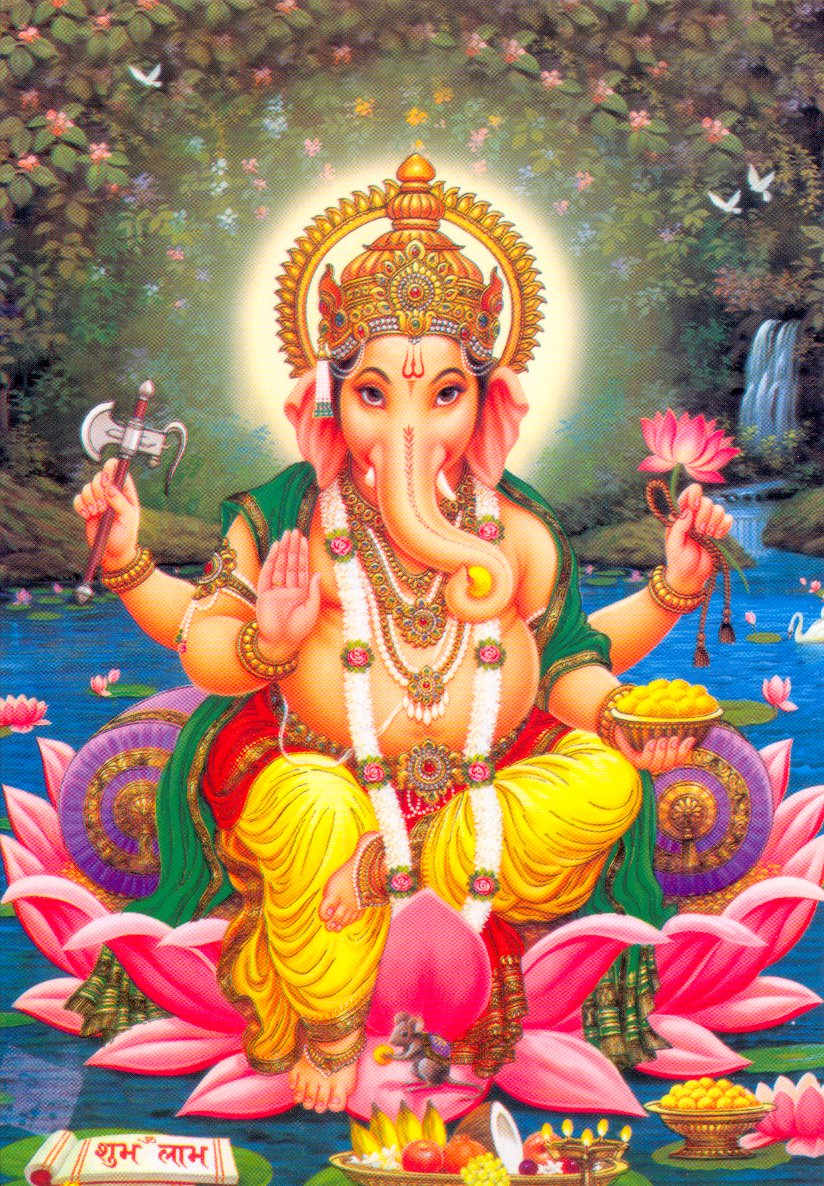
Ganesha – God of wisdom, knowledge and new beginnings
114495892652
Buddhism
Buddhism is based on the teachings of Siddhartha Buddha. The general creed of Buddhism is based on the “four noble truths” and the “eightfold path.”
The truths are:
- Life’s a bitch.
- The reason life’s a bitch is that people are attached to material things.
- Life doesn’t always have to be a bitch. You can achieve nirvana.
- The way to achieve nirvana is by following the eightfold path.
Naturally, when you hear about these truths, you’re going to be curious about the eightfold path, which consists of:
- Right views, i.e., smarten up.
- Right intentions. Once you’re smart, try to do the right thing.
- Right speech. Say the right thing.
- Right action. Knowing and saying the right thing isn’t good enough, you have to actually do the right thing.
- Right livelihood. Make your living in an honorable way, i.e., don’t work for Halliburton.
- Right effort. All of the above doesn’t just happen on its own. You have to work at it.
- Right mindfulness. Once you’ve beaten your physical self into
submission, you have to start working on your mental state, seeking the
ability to think clearly and see things as they really are. - Right concentration. Focus, focus, focus! The path is only
complete when you have refined your mind into a state of total focus on
reality, which is generally thought to be accomplished by the process of
meditation.
Following the eightfold path is key to Buddhism’s system of spiritual
advancement, in which doing the right thing (as outlined above) earns
you karma, metaphysical bonus points which can be exchanged for only one
fabulous prize, Nirvana. In order to make the trade, however, you have
to accumulate an unspecified number of karma points, a process which
usually takes several lifetimes. (Your karma points roll over when
you’re reincarnated.) Alternatively, you can lose karma points by
engaging in wrong views, wrong intentions, wrong speech, wrong actions,
and so on.
The Buddhist concept of karma comes from Hinduism, and some Buddhists
revere Hindu deities. Buddhists also believe in yin and yang, which is
drawn from Taoism.