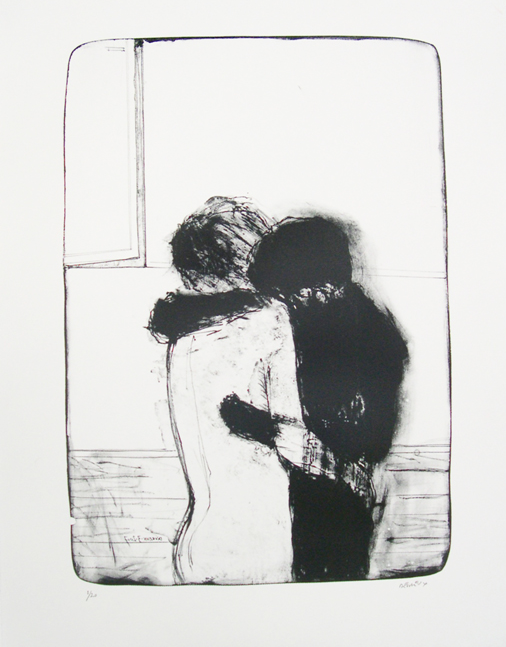
Object-Oriented Ontology (OOO) isn’t an art movement originally, but a philosophical framework that’s had influence in contemporary art and theory.
Here’s the gist:
What it is: OOO is a branch of speculative realism, developed mainly by Graham Harman, Levi Bryant, and Ian Bogost in the early 2000s.
Core idea: Objects exist independently of human perception. A chair, a rock, a virus, or even a fictional character has its own reality that isn’t reducible to how humans experience or use it.
Why it matters for art: Traditional Western art has long been human-centered — even abstract or minimalist works are often framed around human meaning or perception. OOO pushes back against this “anthropocentrism.”
In art practice: Artists influenced by OOO often explore the agency of objects themselves, how materials interact with each other, or how nonhuman entities (machines, ecosystems, algorithms) shape reality. This can look “anti-human figure” because the focus shifts from people to things.
Examples in art influenced by OOO:
Installations where objects “confront” viewers as independent beings.
Works that emphasize materiality — like how steel, plastic, or digital code behaves on its own.
Ecological and post-humanist art that treats humans as just one actor among many.
So in a sense, OOO isn’t anti-human like Suprematism or Constructivism were, but it de-centers humans — making the human figure no longer the default subject of art.
According to information provided by the Human Rights Foundation on 7 August and verified by ArtReview, representatives of the Bangkok Metropolitan Administration (the main funder of BACC) accompanied by Chinese embassy officials visited the exhibition on 27 July, three days after it opened, and flagged several works as ‘problematic’. Works by Hong Kong artists Clara Cheung and Gum Cheng Yee Man, Tibetan artist Tenzin Mingyur Paldron and Uyghur artist Mukaddas Mijit were removed or obscured and the names of the artists were blacked out.
“I still think science is looking for answers and art is looking for questions.” ⠀ Quinn sees the skeleton as representative of an everyman, an abstraction of a person since it is the part of the body which transcends death. The sculptures Angel and Waiting for Godot take the form of a praying skeleton and are an ironic reference to the idea of waiting for answers – or for some kind of external power to guide our life. ⠀ Marc Quinn Waiting for Godot 2006 Patinated bronze 77h x 37w x 76.5d cm
“Real art doesn’t have a message, doesn’t necessarily say anything. It is an arrangement of shapes, a pattern of words. If you want an antidote to this idea of art, watch Bob Dylan manically arranging and rearranging words on a shop sign he and the band spotted one day. That is art.”
Ideas have fathers One of the many destructive assumptions nowadays is that ideas have no fathers. But ideas are thought up by someone. For example, the concept of placing a sculpture on the ground without a plinth was one of Judd’s ideas; it is now very common and no one is aware of this. Another one of his ideas was the concept of the installation, the use of the whole space. Many artists devalue this idea. Once again there is no discussion at all and mediocre works are created. Art historians who are concerned with the past are at least still interested in chronology, those who work with contemporary art are not, and they see art as the subject for their own speculations.
Artist Donald Judd (1928 – 1994) held the 1993 Mondrian Lecture called ‘Some aspects of colour in general and red and black in particular’.
“One could consider that the choices made are like a paradox. It can be seen as a paradox for the painter to not choose the color of his canvas, but I want the charge-taker to decide, since ultimately he has to live with it.”— Claude Rutault
Claude Rutault was a French both minimalist and conceptual artist, best known for the original way of expression he created and named definition-method, which is basically a manual how to create his art piece.
Installation view of After the Masters: A Tribute to Claude Rutault (1941–2022) at Musée d’Orsay, 2023