Quote of the Day
126080508397
“It’s as if the artist is the animal and the painting is the record
of the artist’s tracks through space and time … I did not want just a
record, but rather the actual movement.”
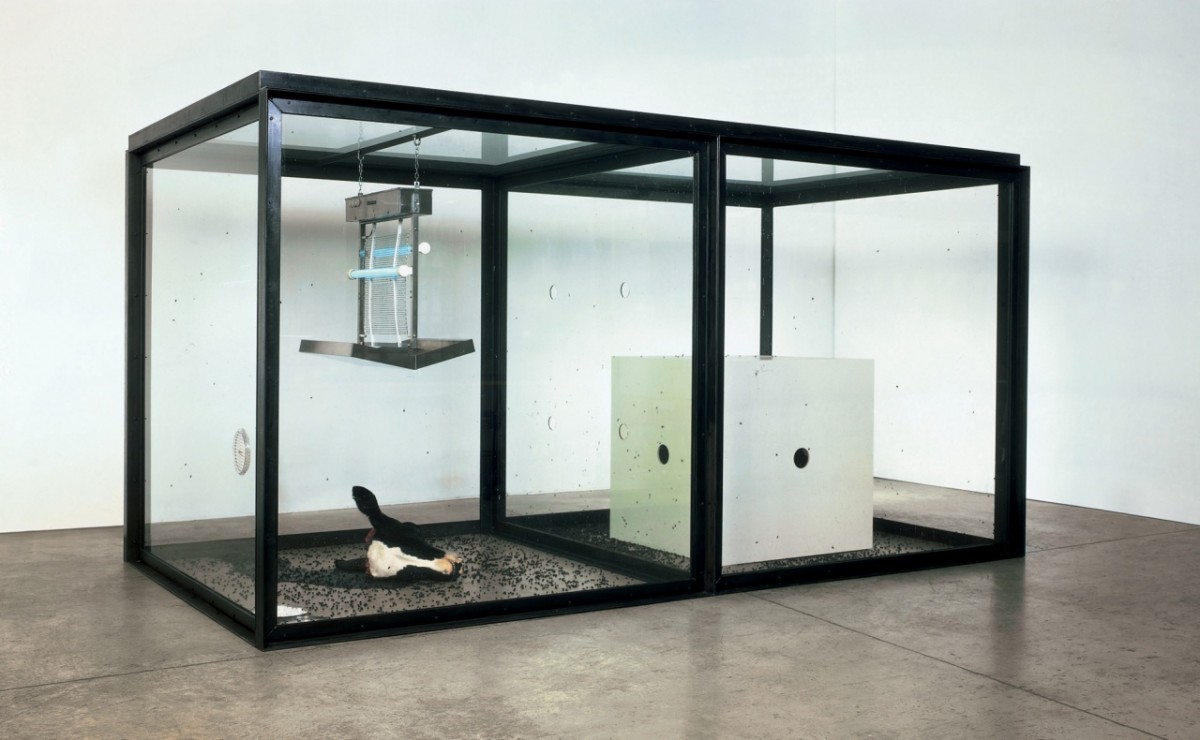
‘A Thousand Years’ and ‘A Hundred Years’ were first exhibited at the warehouse show ‘Gambler’, in 1990. ‘A Thousand Years’ is acknowledged by the artist to be one of the most important of his career.
In both works, the vitrine is split in half by a glass wall: a hole
in this partition allows newly hatched flies from a box reminiscent of a
die in one half, to fly into the other where an Insect-O-Cutor hangs.
The corpses of the flies inside the vitrine accumulate whilst the works
are on exhibition. In ‘A Thousand Years’, a decaying cow’s head is
presented beneath the fly-killer.
Hirst describes how, having come round to the idea of the validity of “new art” and having made the spot paintings and the ‘Medicine Cabinets’,
he felt he had lost something, “in terms of the belief I had in whether
[art] was real or not.” Feeling the need to make “something about something
important”, and having already worked with flies, maggots and
butterflies, whilst at Goldsmiths, he decided to create a “life cycle in
a box.” The structure was partially inspired by American minimalism and the
industrial materials Hirst had seen in the work of Grenville Davey and
Tony Cragg. The shape of the vitrine drew from Francis Bacon’s technique
of framing his figures within box shapes. Of the influence of Bacon’s
frames to his work, Hirst has explained: “it’s a doorway, it’s a window;
it’s two-dimensional, it’s three-dimensional; he’s thinking about the
glass reflecting.”
Having planned the works for almost two years, Hirst had to borrow
money from friends in order to finance their fabrication. Despite this,
he insisted on making two, “like bookends”.
Throughout his career, pairs and duplicates have remained an important
element to Hirst’s work. He states: “It undermines this idea of being
unique. There’s a comfort I get from it that I love. Each part of a pair
has its own life, independent of the other, but they live together.”
‘A Thousand Years’ and ‘A Hundred Years’ synthesize two forces
central to Hirst’s work: the desire to create an aesthetically
successful visual display, and an exploration into the deep profundities
of life and death. Although admitting to having a “Frankenstein moment”
of horror at the death of the flies, the use of living creatures
enabled Hirst to incorporate an element of movement into the
works. After studying Naum Gabo, Hirst found that the flies successfully
satisfied his ambition to “suspend things without strings or wires and have them constantly change pattern in space”.
The artist Lucian Freud stated that, with ‘A Thousand Years’ being
one of his earliest exhibited pieces, Hirst had perhaps “started with
the final act”. Explaining that, “your whole life could be like
points in space, like nearly nothing,” Hirst provokes a reconsideration
of how we respond to death in the works; the fate of the flies at the
hands of a machine that is commonplace even in vegetarian restaurants,
is rendered uncomfortable by the gallery setting. Of the thematic prevalence of death in his work, Hirst explains: “You
can frighten people with death or an idea of their own mortality, or it
can actually give them vigour.”
by Damien Hirst
126012107682
It was like the big corporations, the big machine didn’t want us to succeed or exist. We were shaking things up, and they fought against us, as far as not being able to get radio play and throwing any obstacle they could in our path. We were like aliens.
125827978402
IMS Engage 2014: David Lynch In Conversation With Moby
125823699852
A Picture of Dorian Gray
The artist is the creator of beautiful things. To reveal art and conceal the artist is art’s aim.
The critic is he who can translate into another manner or a new material his impression of beautiful things.
The highest as the lowest form of criticism is a mode of autobiography.
Those who find ugly meanings in beautiful things are corrupt without being charming. This is a fault.
Those who find beautiful meanings in beautiful things are the cultivated. For these there is hope.
They are the elect to whom beautiful things mean only beauty.
No artist desires to prove anything. Even things that are true can be proved.
No artist has ethical sympathies. An ethical sympathy in an artist is an unpardonable mannerism of style.
No artist is ever morbid. The artist can express everything.
Thought and language are to the artist instruments of an art.
Vice and virtue are to the artist materials for an art.
From the point of view of form, the type of all the arts is the art of the musician. From the point of view of feeling, the actor’s craft is the type.
All art is at once surface and symbol.
Those who go beneath the surface do so at their peril.
Those who read the symbol do so at their peril.
It is the spectator, and not life, that art really mirrors.
Diversity of opinion about a work of art shows that the work is new, complex, and vital.
When critics disagree, the artist is in accord with himself.
We can forgive a man for making a useful thing as long as he does not admire it. The only excuse for making a useless thing is that one admires it intensely.
All art is quite useless.
— Oscar Wilde, from ‘A Picture of Dorian Gray’
125653833567
Animals don’t hate, and we’re supposed to be better than them.
125433461627