Quote of the Day
117531635660
I would love to believe that when I die I will live again, that some thinking, feeling, remembering part of me will continue. But much as I want to believe that, and despite the ancient and worldwide cultural traditions that assert an afterlife, I know of nothing to suggest that it is more than wishful thinking. The world is so exquisite with so much love and moral depth, that there is no reason to deceive ourselves with pretty stories for which there’s little good evidence. Far better it seems to me, in our vulnerability, is to look death in the eye and to be grateful every day for the brief but magnificent opportunity that life provides.
117520105957
J. G. Ballard
NTERVIEWER
So, how do you write, exactly?
BALLARD
Actually, there’s no secret. One
simply pulls the cork out of the bottle, waits three minutes, and two
thousand or more years of Scottish craftsmanship does the rest.
INTERVIEWER
Let’s
start with obsession. You seem to have an obsessive way of repeatedly
playing out permutations of a certain set of emblems and concerns.
Things like the winding down of time, car crashes, birds and flying,
drained swimming pools, airports, abandoned buildings, Ronald Reagan…
BALLARD
I
think you’re completely right. I would say that I quite consciously
rely on my obsessions in all my work, that I deliberately set up an
obsessional frame of mind. In a paradoxical way, this leaves one free of
the subject of the obsession. It’s like picking up an ashtray and
staring so hard at it that one becomes obsessed by its contours, angles,
texture, et cetera, and forgets that it is an ashtray—a glass dish for
stubbing out cigarettes. Presumably all obsessions are extreme metaphors waiting to be born.
That whole private mythology, in which I believe totally, is a
collaboration between one’s conscious mind and those obsessions that,
one by one, present themselves as stepping-stones.
INTERVIEWER
Your work also seems tremendously influenced by the visual arts.
BALLARD
Yes, sometimes I think that all my writing is nothing more than the compensatory work of a frustrated painter.
INTERVIEWER
How does a book take shape for you?
BALLARD
That’s
a vast topic, and, to be honest, one I barely understand. Even in the
case of a naturalistic writer, who in a sense takes his subject matter
directly from the world around him, it’s difficult enough to understand
how a particular fiction imposes itself. But in the case of an
imaginative writer, especially one like myself with strong affinities to
the surrealists, I’m barely aware of what is going on. Recurrent ideas
assemble themselves, obsessions solidify themselves, one generates a set
of working mythologies, like tales of gold invented to inspire a crew. I
assume one is dealing with a process very close to that of dreams, a
set of scenarios devised to make sense of apparently irreconcilable
ideas. Just as the optical centers of the brain construct a wholly
artificial three-dimensional universe through which we can move
effectively, so the mind as a whole creates an imaginary world that
satisfactorily explains everything, as long as it is constantly updated.
INTERVIEWER
How many hours a day do you put in at the desk?
BALLARD
Two hours in the late morning, two in the early afternoon, followed by a walk along the river to think over the next day. Then at six, Scotch and soda, and oblivion.
INTERVIEWER
That sounds like the schedule of an efficient worker.
INTERVIEWER
Aside
from your adolescent dream of becoming a psychiatrist, do you have any
other pet daydreams about other lives, other careers?
BALLARD
I haven’t really had any private fantasies about an alternative life, even in the daydream sense. I rather like the idea of ending my days drinking myself to death on a mountainside in Mexico.
117503172052
117506173697
How To Be Positive | by Ajahn Brahm
117497434981
Hometown: Shaolin, New York
117480704326
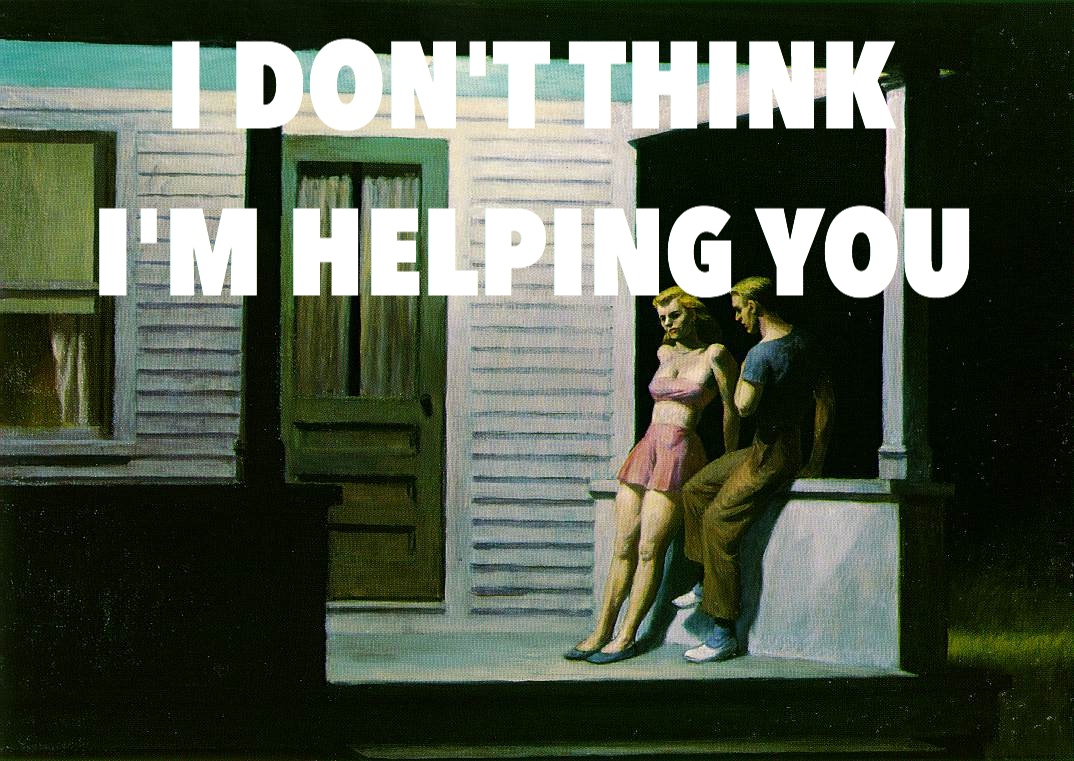
Summer Evening by Edward Hopper // Head.Cars.Bending by The 1975
117474995956