I believe art matters most when it changes how we look at the world. Pollock did that with abstract expressionism, Warhol did it with pop art, and Judd did it through minimalism. Each of them helped people see art in a new way — and that kind of influence is what gives their work real meaning and value.
I believe art matters most when it changes how we look at the world. Pollock did that with abstract expressionism, Warhol did it with pop art, and Judd did it through minimalism. Each of them helped people see art in a new way — and that kind of influence is what gives their work real meaning and value.
“When I was a younger man, art was a lonely thing. No galleries, no
collectors, no critics, no money. Yet, it was a golden age, for we all
had nothing to lose and a vision to gain. Today it is not quite the
same. It is a time of tons of verbiage, activity, consumption. Which
condition is better for the world at large I shall not venture to
discuss. But I do know, that many of those who are driven to this life
are desperately searching for those pockets of silence where we can root
and grow. We must all hope we find them.”
“There is a big stone. Do you consider it to be inside or outside your mind?” ⠀ Abstract Art Series: The Stone Mind Poster. Size: 18 x 24 in. On a matte paper. Heavyweight stock.
Both physical and NFT items are now available in our store.
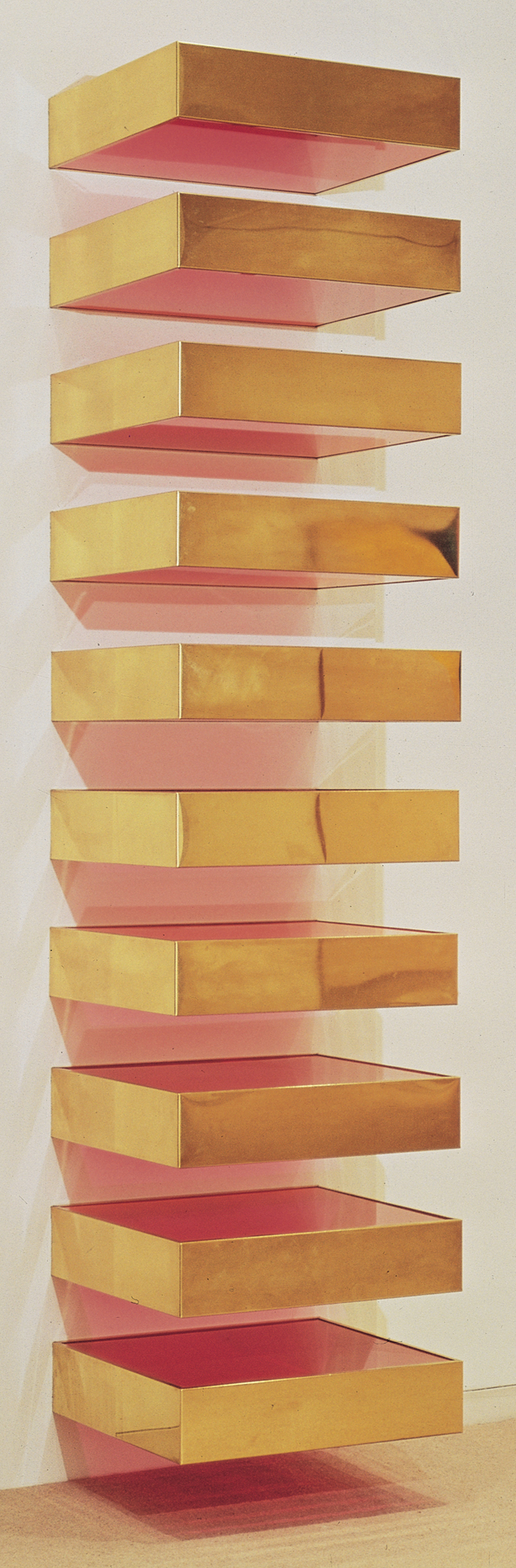
Ideas have fathers One of the many destructive assumptions nowadays is that ideas have no fathers. But ideas are thought up by someone. For example, the concept of placing a sculpture on the ground without a plinth was one of Judd’s ideas; it is now very common and no one is aware of this. Another one of his ideas was the concept of the installation, the use of the whole space. Many artists devalue this idea. Once again there is no discussion at all and mediocre works are created. Art historians who are concerned with the past are at least still interested in chronology, those who work with contemporary art are not, and they see art as the subject for their own speculations.
Artist Donald Judd (1928 – 1994) held the 1993 Mondrian Lecture called ‘Some aspects of colour in general and red and black in particular’.
“One could consider that the choices made are like a paradox. It can be seen as a paradox for the painter to not choose the color of his canvas, but I want the charge-taker to decide, since ultimately he has to live with it.”— Claude Rutault
Claude Rutault was a French both minimalist and conceptual artist, best known for the original way of expression he created and named definition-method, which is basically a manual how to create his art piece.
Installation view of After the Masters: A Tribute to Claude Rutault (1941–2022) at Musée d’Orsay, 2023
Style often helps categorize and define art, making it easier for people to understand and discuss different periods, techniques, and themes in art history. Without a recognizable style, art can become more challenging to classify. However, this does not mean that art without a defined style lacks value or meaning. It just means that it may not fit neatly into the traditional frameworks that we’ve created for understanding art.
In the absence of a specific style, art may be categorized by other criteria, like the concepts behind the work, its intentions, or even its context (social, political, or cultural). For instance, conceptual art is categorized by the ideas it expresses rather than the visual style itself. Similarly, installation art might focus more on how the work interacts with space and the viewer than on the style of its execution.
In some ways, art without style challenges the idea that all art must be categorized in a specific way. It opens up a broader interpretation, where the meaning and impact of the art can come from its message or experience rather than its form.
Do you find this lack of style freeing, or do you think art needs some form of structure to be appreciated?
An art movement is a style or trend in art that is followed by a group of artists during a specific period. These movements often share common techniques, themes, or philosophies. They can be influenced by historical events, cultural shifts, or technological advancements.
For example:
Impressionism (late 19th century) focused on capturing light and everyday life with loose brushwork.
Surrealism (20th century) explored dreams and the unconscious mind with strange, dreamlike imagery.
Abstract Expressionism (mid-20th century) emphasized spontaneous and emotional brushstrokes rather than realistic representation.
Art movements help categorize different styles and ideas in art history. Do you have a particular movement you’re interested in?
“I am not interested in the kind of expression that you have when you
paint a painting with brush strokes. It’s all right, but it’s already
done and I want to do something new. I didn’t want to get into something
which is played out and narrow. I want to do as I like, invent my own
interests. Of course, that doesn’t mean that people who, like Newman,
still paint are worn out. But I think that’s a particular kind of
experience involving a certain immediacy between you and the canvass,
you and the particular kind of experience of that particular moment. I
think what I’m trying to deal with is something more long range than
that in a way, more obscure perhaps, more involved with things that
happen over a longer time perhaps. At least it’s another area of
experience.”