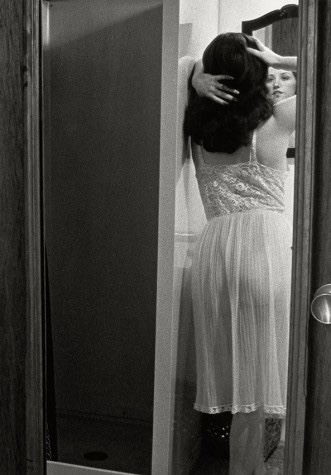
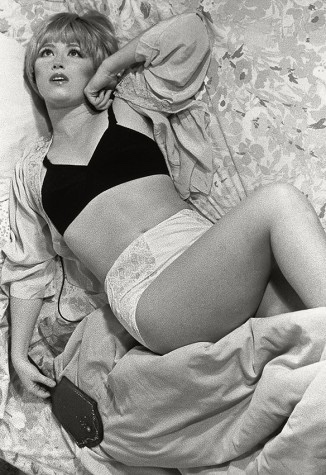
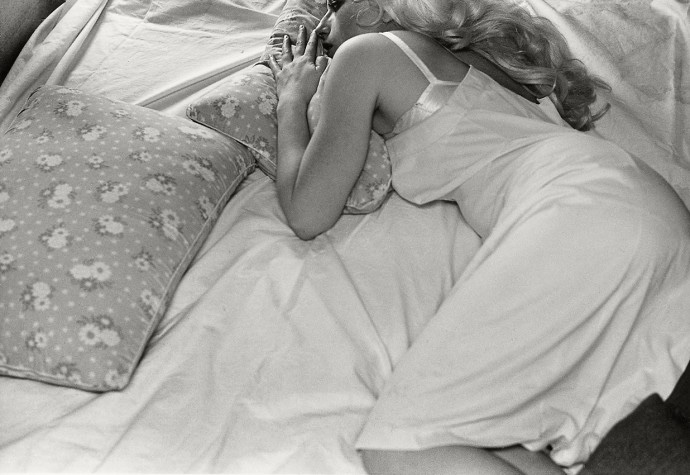
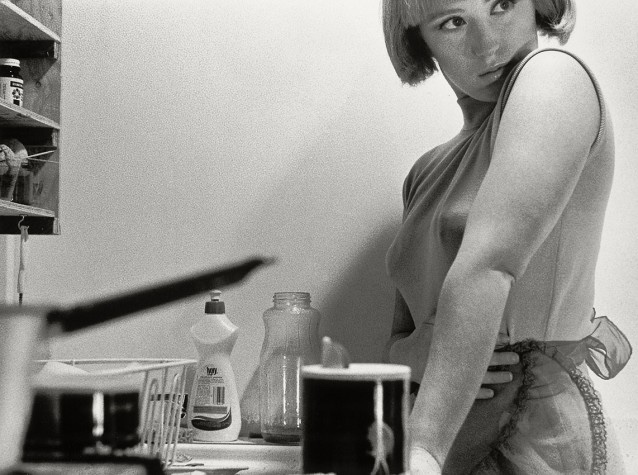
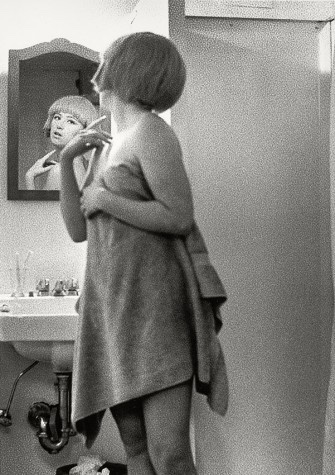
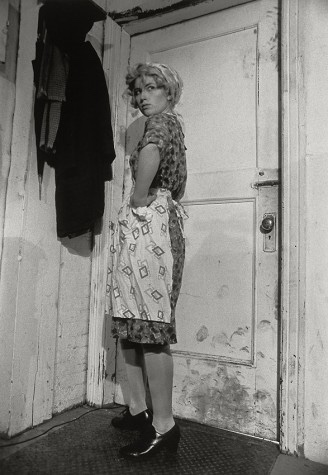
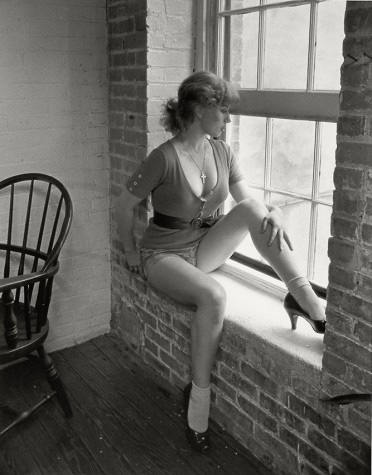
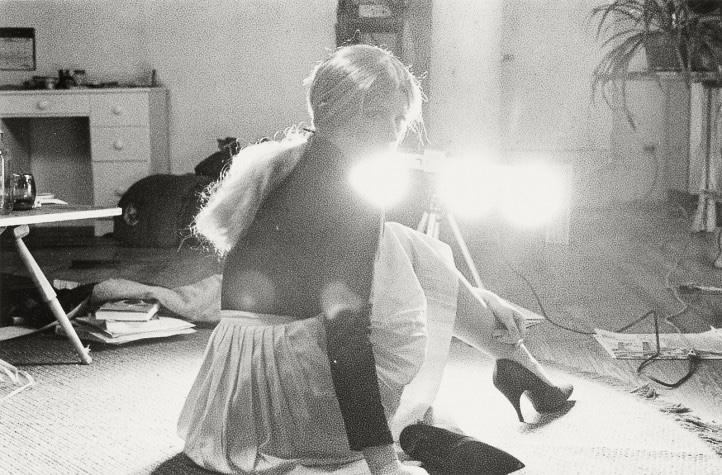
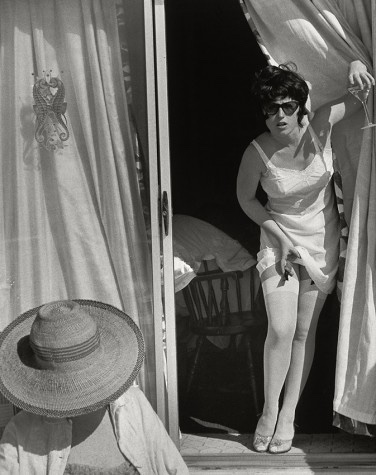
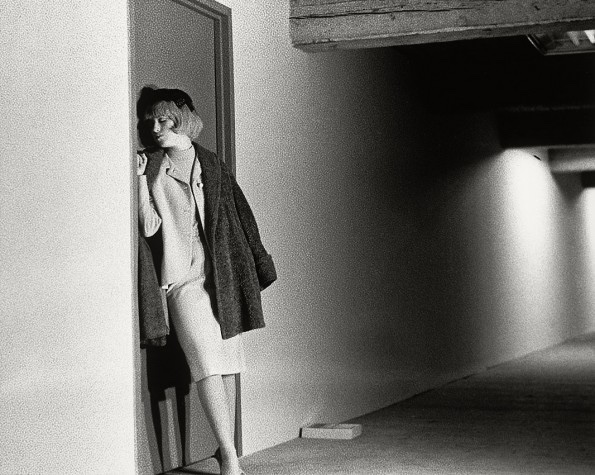
In fall 1977, Sherman began making pictures that would eventually become her groundbreaking “Untitled Film Stills.” Over three years, the series grew to comprise a total of seventy black-and-white photographs. Taken as a whole, the “Untitled Film Stills”—resembling publicity pictures made on movie sets—read like an encyclopedic roster of stereotypical female roles inspired by 1950s and 1960s Hollywood, film noir, B movies, and European art-house films. But while the characters and scenarios may seem familiar, Sherman’s “Stills” are entirely fictitious; they represent clichés (career girl, bombshell, girl on the run, vamp, housewife, and so on) that are deeply embedded in the cultural imagination. While the pictures can be appreciated individually, much of their significance comes in the endless variation of identities from one photograph to the next. As a group they explore the complexity of representation in a world saturated with images, and refer to the cultural filter of images (moving and still) through which we see the world.
“Art has been valued and given importance through the artist, regarded as the one who creates something wondrous and beautiful. At a certain point, artists within that way of thinking often distance themselves more and more from the community and society. In Thai education, this system of teaching and learning art is still being used.”
“When art is no longer the center of the universe, then artists are not either. This has been a question asked of artists since the time of Walter Benjamin. He spoke about this long ago, and it has been written about for a long time.
“In the modernist view, the artist was seen as something close to a superhuman — exalted as someone with supreme specialness, with an intuition that could not be explained. When the artist was elevated above us, above the university guard or the noodle vendor next door, the artist became like a kind of demi-god, regarded as more special than anyone else.
“In fact, in contemporary thought, the artist is like a motorcycle taxi driver — it’s just another profession. We work within a framework of knowledge that is not some kind of miracle. And art itself depends on other bodies of knowledge.”
Jiradej Meemalai Co-founder of ‘Baan Noorg Collaborative Arts & Culture’
“เมื่อศิลปะไม่เป็นศูนย์กลางจักรวาล ศิลปินก็จะไม่เป็นด้วย ซึ่งศิลปินเคยถูกตั้งคำถามนี้มาตั้งแต่สมัย Benjamin Walter เขาพูดเรื่องนี้มานานแล้ว หนังสือก็เขียนมานานแล้ว
“Christie’s is closing its digital art department and has parted ways with Nicole Sales Giles, the auction house’s vice president of digital, Now Media reported Monday.”
“So, while many are keen to talk things down, the reality is more nuanced. Indeed, this isn’t the first time the U.S. art market has asked itself such questions. ‘The art world has an enormous capacity for reinvention,’ said Robb. ‘We’re all creative. We’re representing creatives. We’re creative in our own ways. This is an opportunity for some exciting change to take shape.’”
The artist is the creator of beautiful things. To reveal art and conceal the artist is art’s aim.
The critic is he who can translate into another manner or a new material his impression of beautiful things.
The highest as the lowest form of criticism is a mode of autobiography.
Those who find ugly meanings in beautiful things are corrupt without being charming. This is a fault.
Those who find beautiful meanings in beautiful things are the cultivated. For these there is hope.
They are the elect to whom beautiful things mean only beauty.
No artist desires to prove anything. Even things that are true can be proved.
No artist has ethical sympathies. An ethical sympathy in an artist is an unpardonable mannerism of style.
No artist is ever morbid. The artist can express everything.
Thought and language are to the artist instruments of an art.
Vice and virtue are to the artist materials for an art.
From the point of view of form, the type of all the arts is the art of the musician. From the point of view of feeling, the actor’s craft is the type.
All art is at once surface and symbol.
Those who go beneath the surface do so at their peril.
Those who read the symbol do so at their peril.
It is the spectator, and not life, that art really mirrors.
Diversity of opinion about a work of art shows that the work is new, complex, and vital.
When critics disagree, the artist is in accord with himself.
We can forgive a man for making a useful thing as long as he does not admire it. The only excuse for making a useless thing is that one admires it intensely.
“A man who works with his hands is a laborer; a man who works with his hands and his brain is a craftsman; but a man who works with his hands and his brain and his heart is an artist.”
Art and narrative are closely connected because storytelling is a powerful way to convey meaning, emotion, and context. Here are a few reasons why art often needs a narrative:
1. Contextual Understanding: A narrative provides context that helps viewers understand the deeper meaning or message of the artwork. Without a story, the interpretation of art can be vague or ambiguous.
2. Emotional Engagement: Stories evoke emotions, and when art is tied to a narrative, it can resonate more deeply with the audience, making the experience more impactful.
3. Connection with the Audience: A narrative allows viewers to relate the artwork to their own experiences, thoughts, or feelings, creating a personal connection between the art and the audience.
4. Cultural and Historical Significance: Art often reflects the time, place, and culture in which it was created. A narrative can highlight these aspects, making the artwork more meaningful in a broader context.
5. Guiding Interpretation: While art can be open to interpretation, a narrative can guide viewers toward a particular understanding or theme, helping to convey the artist’s intended message more clearly.
6. Creating a Legacy: Narratives can preserve the stories behind art, ensuring that future generations understand and appreciate the significance of the work.
“Sotheby’s modern evening sale fetched $186.4 million on May 13th. The sale’s most highly anticipated lot—Alberto Giacometti’s Grande tête mince (1955), estimated in excess of $70 million—failed to attract a buyer.”